



Introduction
In contemporary US right-wing and “New Atheist” circles, a specific 1786 document is frequently weaponized to frame Islam as inherently expansionist and violent. Most notably, the late Christopher Hitchens used the correspondence between Thomas Jefferson, John Adams, and the Tripolitan Ambassador, Abd al-Rahman Aga, to argue that Islamic fundamentalism has been at “holy war” with the West since the birth of the American Republic. However, a closer examination of the document, the linguistic context, and the Ambassador’s true character reveals a narrative built on selective bias and political convenience rather than historical truth.

The Problematic Document
The cornerstone of this argument is a letter dated March 28, 1786, from the American Commissioners to John Jay. In it, Jefferson and Adams recount their inquiry into why Tripoli felt entitled to prey upon American shipping:
“The Ambassador answered us that it was founded on the Laws of their Prophet… that it was their right and duty to make war upon [all nations who should not have acknowledged their authority]… and that every Musselman who should be slain in battle was sure to go to Paradise.”
While this text is often presented as a literal “declaration of war,” historians such as Robert J. Allison in The Crescent Obscured suggest a much more nuanced reality.
The Linguistic Filter and “Orientalist” Projection
The first major flaw in the Hitchens argument is the assumption of a direct, transparent transcript. The 1786 meeting was not conducted in English or Arabic, but likely in Italian, the Lingua Franca of 18th-century Mediterranean diplomacy.
As Allison argues, Jefferson and Adams, both children of the Enlightenment, viewed the world through a lens that sought to categorize “The East” as a monolith of “Despotism” and “Fanaticism.” When Abd al-Rahman Aga utilized the standardized religious rhetoric of the time to justify what was essentially a maritime “shakedown” for protection money (tribute), the Americans transcribed it as a theological mandate. They likely “heard” exactly what they needed to hear to justify the creation of a permanent U.S. Navy to a cash-strapped and sceptical Continental Congress.
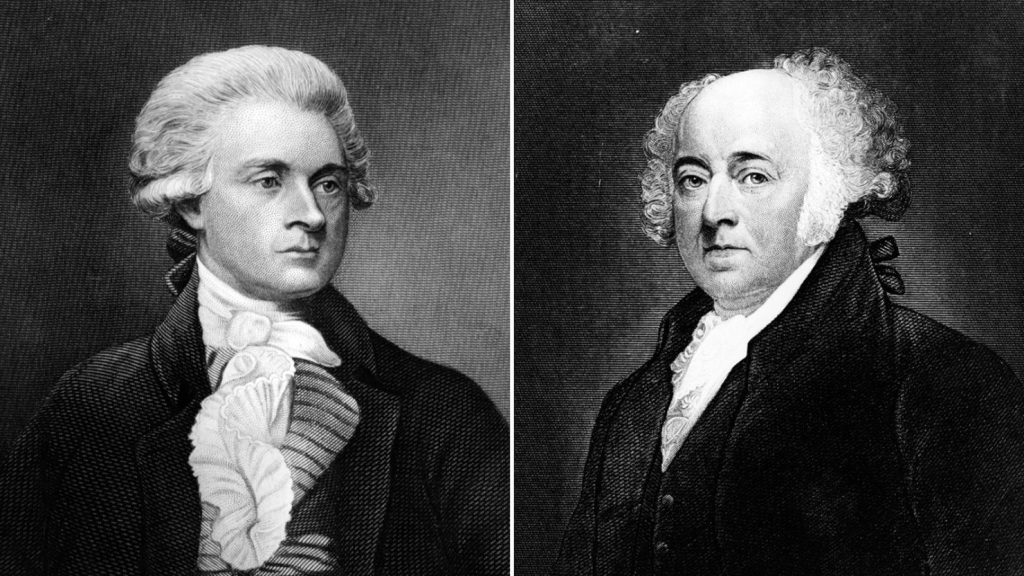
Jefferson and Adams
The Character Contradiction
The “Religious Fanatic” depicted by Jefferson stands in stark contrast to the cosmopolitan intellectual documented by European contemporaries. Miss Tully, sister of the British Consul in Tripoli, provided a far more intimate portrait of the Ambassador in her Narrative of a Ten Years’ Residence at Tripoli:
“Through his distinguished conduct, he has obtained precious tokens of favour from different sovereigns… He enjoys such an excellent reputation here that he is as generally loved by Christians as by Moors.” — Miss Tully, Narrative of a Ten Years’ Residence at Tripoli
Abd al-Rahman Aga was a man of the Enlightenment in his own right, a collaborator with the Danish scholar Carsten Niebuhr and a member of the Royal Swedish Academy of Sciences. A man truly driven by a mandate to “enslave all non-believers” would not have dedicated his career to scientific exchange and maintaining deep, respectful friendships with European Christians.
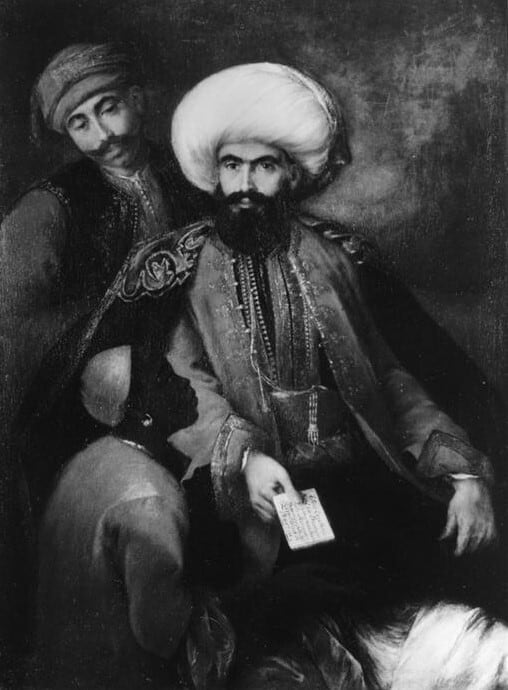
Legal Pragmatism vs. Theological Zeal
From the perspective of Islamic Law, the Hitchens argument falls apart on technical grounds. The concepts of Sulh (treaty) and Aman (safe-conduct) have historically superseded the general state of war. If Tripoli’s actions were purely a religious mandate, they would have been at war with all of Christendom perpetually. Instead, the Regency maintained long-standing, stable peace treaties with Great Britain and France.
The conflict with the United States was not a “Clash of Civilizations,” but a mercantilist dispute. The U.S., having lost the protection of the British Crown, refused to pay the established maritime tolls (tribute). The Ambassador’s use of religious language was a diplomatic tactic, a “non-negotiable” framing, to maximize his leverage in a high-stakes financial negotiation.
Conclusion: The Immorality of Selective History
The revival of the Hitchens trope by modern US and Europe conservative groups is a classic example of manufacturing consent through historical nihilism. By stripping Abd al-Rahman Aga of his cosmopolitan identity and reducing a complex maritime conflict to a binary “Holy War,” these groups manufacture fear to serve contemporary political agendas. To use history untruthfully is not just a scholarly error, it is a symptom of the decadence and moral decline currently pervading Western political discourse.