

“Allow me to state clearly at this stage that I do not belong to that tribe of historians who hold to the belief that those who fail to learn from history are doomed to repeat it. The sad fact is that many a warmongering-mass murderer did know quite a bit of history, and may have even improved upon their methods of genocide, conquest and colonisation by consulting the works of historians in the pat.”
– Professor Farish A. Noor
The above passage was cited from a book authored by Professor Farish, titled The Long Shadow of the 19th Century which is a work compiling his essays with the focus on the colonial days of this subregion.
For the reader’s context, Professor Farish was referring to a widely-used passage written by a Spanish-American philosopher named George Santayana in his book titled The Life of Reason, where he wrote; “Those who cannot remember the past are condemned to repeat it”.
This was the very passage used by a lot of educators in endorsing the teachings and learnings of history. But it seems that Professor Farish, on the other hand, has a different view on the matter which Santayana had mentioned.
Reading that passage from Professor Farish’s book halted my reading flow. It came across my mind that his view is somewhat reasonable looking from the current perspective of this chaotic world we are living in.
We have always been shoved with Santayana’s perspective which endorses progression in learning history, which is not incorrect. But with this new addition, our perspective may now be widened and therefore shall our mind be more critical in approaching the study of history now.
Let us then look back into the discourse of history to relate ourselves to the circulation of thoughts in what Professor Farish had written about.
Do you remember a Dutch name we may have learnt in school; Christiaan Snouck Hurgronje? His name was cited in our history textbook for his theory of the arrival of Islam in the Malay Archipelago where his theory presented the idea of Islam arriving here from the Indian subcontinent.
However, that is not the point of bringing his name into this discussion. While he might have been portrayed as an Orientalist who had performed extensive studies on Islam, he was somewhat far from what we could consider as a noble individual.
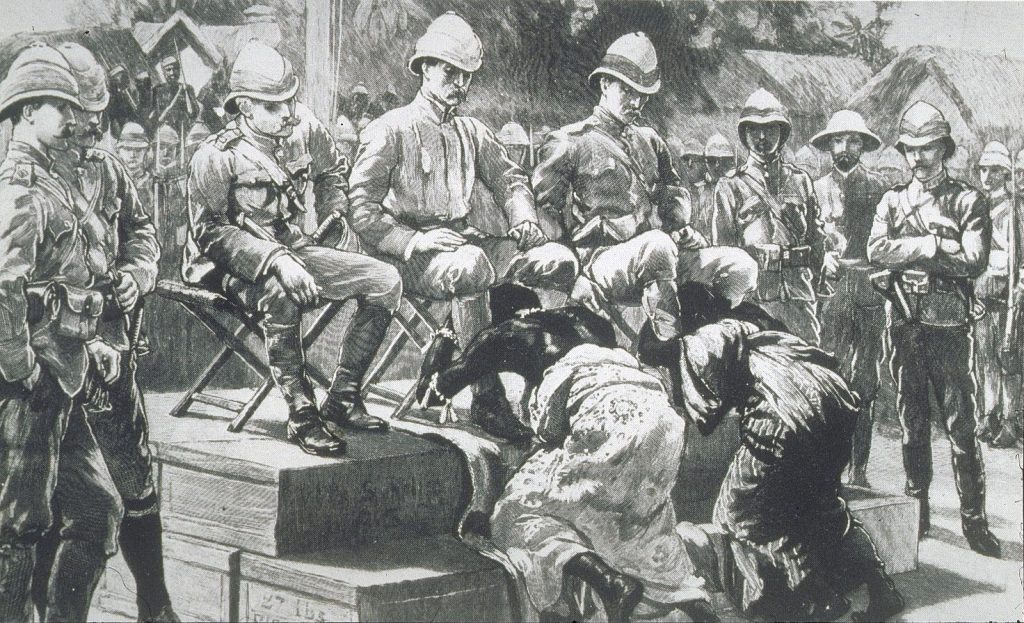
To briefly narrate what exactly he had done, his deep understanding on Islam and the local community of Indonesia, Aceh especially was really helpful for the Dutch in securing further control over Indonesia.
He was the person who has provided the necessary social information in structuring a more oppressive colonial policy over Aceh where the Dutch had managed to further suppress the anti-colonial movement there, thanks to his deep understanding of Acehnese history and social structure.
We, however, are not going to discuss history now thus moving back to the passage, what Professor Farish had said now can be further related to our understanding that history may be looked at from different perspectives, depending on what we are seeking from history.
To put it in the path of the laymen, looking from both perspectives could and would mean that we are seeking lessons from history. The question in place now is what we do next with the lessons gained from that search of ours.
Therefore when it comes to that matter, I am most reminded of what the late Professor Syed Naquib al-Attas had argued in his work, Islam and Secularism. From the chapter of The Dewesternization of Knowledge, we are taught that knowledge should not stand as a compilation of information or directive alone.
He argued that knowledge, with the essence derived from the Western world, had been further corrupted. With the inclusion of such essence, he argued, that knowledge has lost its direction and therefore the very thing we would refer to as morality or soul.
This may be the very reason knowledge may be utilized as a tool for different purposes, including negative ones, despite the sharing of values, elements and perspectives. We may say that happens due to the blatant pursuit of knowledge with the disappearance of morality or soul in it.
In relation to what is mentioned in the earlier paragraph, Professor al-Attas argued that:-
“… knowledge whose nature has become problematic because it has lost its true purpose due to being unjustly conceived, and has thus brought about chaos in man’s life instead of, and rather than, peace and justice; knowledge which pretends to be real but which is productive of confusion and scepticism, which has elevated doubt and conjecture to the ‘scientific’ rank in methodology and which regards doubt as an eminently valid epistemological tool in the pursuit of truth;”
We could then bring ourselves back to the narration of events circulating the ill-minded act done by Hurgronje in the past. It is of the utmost importance that knowledge comes with it, morality. Inexistence of morality in knowledge will only contribute to the misutilization of it, of which was what had been argued by Professor al-Attas too :
“But the fusion and amalgamation thus evolved produced a characteristic dualism in the world view and values of Western culture and civilization; a dualism that cannot be resolved into a harmonious unity, for it is formed of conflicting ideas, values, cultures, beliefs, philosophies, dogmas, doctrines and theologies altogether reflecting an all-pervasive dualistic vision of reality and truth locked in despairing combat.”
What was said by Professor al-Attas may then be supported by what was said by his brother, the late Professor Syed Hussein Al-Attas next. Professor Syed Hussein was known for his argument of the concept of ‘captive mind’ in his work, Intellectual Imperialism.
In his work, Professor Syed Hussein argued that Imperialism may also come from the angle of Intellectualism, which he regarded as ‘Intellectual Imperialism’. His argument explains to us that knowledge may be corrupted for the purpose of benefitting the Western world, in the performance of their imperialist acts.
For context, he argued :
“These are the six main traits of imperialism. In addition to political, social and economic imperialism, we are also subjected to intellectual imperialism. Intellectual imperialism is the domination of one people by another in their world of thinking. Intellectual imperialism’ is usually an effect of actual direct imperialism or is an effect of indirect domination arising from imperialism.”
Knowledge is the broad terminology which would then include history too. To relate ourselves back to the original discussion, we now understand the reason both perspectives are applicable in the sense of studying history.
One could either utilize or misutilize history. We are therefore made to understand the necessity of morality in knowledge, for that it will therefore be utilized and not misutilized, for knowledge is the epitome of human’s priciest prize—mind.
Unfortunately, the world we live in today is a realistic dimension where colours are applied everywhere. We can never enforce such perception unto all of the world. What we can do is to start with ourselves. Let us start embracing morality in knowledge.
Writer’s Biodata
Waqqas Zulfiquer is an independent researcher who has published several semi-academical books focusing on history and civilization. He is now actively involved in academic writing relating to colonial and post-colonial studies, where his writings were sent and published by academic journals.
Disclaimer: The views expressed in this article are the personal views of the author and do not represent AkalWahyu as a whole. AkalWahyu is not responsible for any errors of fact, interpretation, or implications arising from this article. AkalWahyu publishes this article as a space for intellectual discourse and discussion of ideas